

Deciding to start Invisalign treatment often comes after months of research, but most of what shows up online focuses on the results, not the day-to-day experience. The practical realities, from how strict the wear schedule actually is to how daily habits shift once aligners are in, tend to surface only after the first tray goes in. Knowing these realities in advance changes how smoothly the first few weeks go.
At White Pine Family Dental, we have guided Reno patients through Invisalign treatment for decades, and the questions that come up most often are rarely about the technology itself. They are about what everyday life looks like once the aligners are in. Dr. Kenneth B. Prince began providing Invisalign in 2004, just five years after it became available on the market, and our team continues ongoing education with some of the leading Invisalign providers in the country. Before you take the next step, here are the practical details worth knowing.
Is Invisalign the Right Fit for Your Case?
Not every case of misalignment responds to clear aligners in the same way. Invisalign treats a wide range of spacing, crowding, and bite concerns, but the complexity of a particular case affects both candidacy and the treatment plan itself. Some situations that once required traditional braces can now be treated with aligners, while others may need a combination approach or a longer series of trays to reach the same result. This is one of the reasons a consultation matters more than a quick online quiz or a friend’s experience, since what worked well for someone else’s teeth may not translate directly to your own bite, spacing, or jaw alignment.
Treatment length varies for the same reason. Some patients complete their series in under a year, while others need considerably longer, and how long Invisalign treatment can take depends heavily on the starting position of the teeth and how consistently the aligners are worn. A consultation is the most reliable way to get a timeline specific to your case, rather than a general estimate.
The Wear Time Requirement Is Non-Negotiable
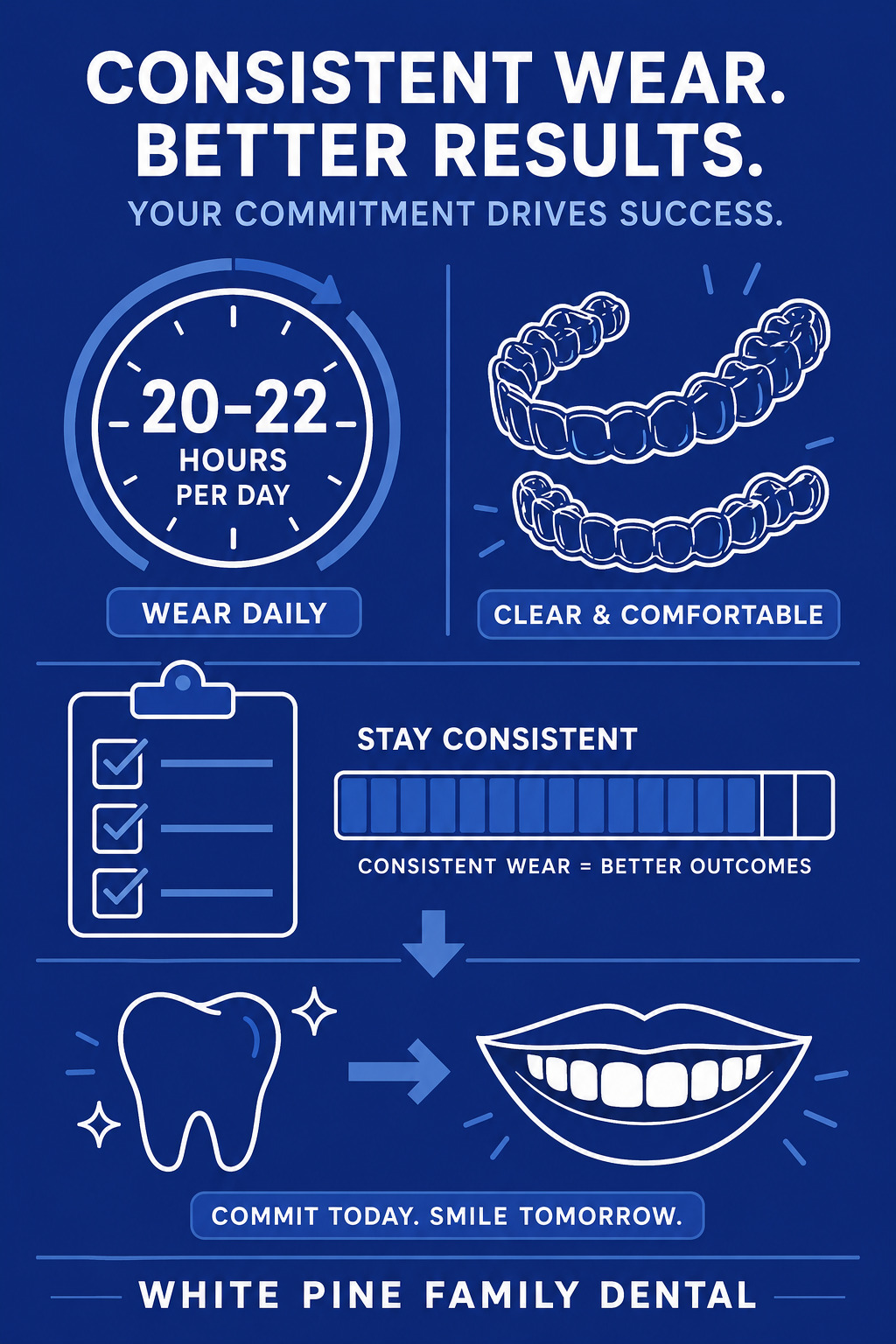
One of the most common misconceptions about Invisalign is that clear aligners offer total flexibility in when you wear them. In practice, aligners need to stay in 20 to 22 hours a day to move teeth on schedule, which leaves a narrow window of two to four hours for eating, drinking anything other than water, and brushing.
Why Compliance Matters More Than Most Patients Expect
A 2025 systematic review published in the National Institutes of Health’s PubMed Central database found that patient compliance is one of the most critical factors in Invisalign treatment predictability, with inadequate wear time directly undermining tooth movement across several types of cases. For most patients, this changes daily habits in real ways: meals get consolidated, snacking slows down, and convenience drinks get reconsidered. Most patients adapt within the first few weeks, but going in with realistic expectations makes the transition much smoother.
What Eating, Drinking, and Cleaning Look Like Day to Day
Because aligners come out for meals, staying compliant also means adjusting how you eat and clean throughout the day. Coffee, tea, wine, and dark sodas can stain the trays if you sip them with aligners in, so most patients get in the habit of removing them first and rinsing before putting them back in. Snacking between meals becomes less convenient too, since each snack means a full removal, rinse, and reinsertion cycle.
Oral hygiene also takes on a slightly different rhythm. Aligners trap plaque and bacteria against the teeth if they go back in over a dirty mouth, so brushing and rinsing after eating becomes part of the routine rather than an occasional habit. Sticking to your daily oral hygiene routine, including regular flossing, keeps both your teeth and your trays cleaner throughout treatment.
Your Speech Will Sound Different at First
Nobody mentions the lisp. When aligners go in for the first time, the tongue does not immediately know how to navigate around the new surface, and sounds like “s” and “th” come out differently than usual.
This is temporary. Most patients find their speech returns to normal within a few days as the tongue adjusts. Reading aloud, having conversations, and simply pushing through it speeds the process along. Some patients also find that practicing in front of a mirror during the first day or two helps the adjustment feel less noticeable to others. By the time most people notice, the adjustment has already passed.
Attachments Are a Normal Part of Treatment Plans
When most people picture Invisalign, they imagine smooth, perfectly clear trays. What the brochures do not always explain is that many treatment plans include attachments, which are small tooth-colored bumps bonded to the surface of specific teeth to help the aligners grip and guide more complex tooth movements. Compared to traditional braces, attachments are far less visible and typically go unnoticed by others in everyday conversation.
What to Expect at Your Appointment
Attachments are matched closely to natural tooth shade and are removed at the end of treatment, so they are not a permanent addition to your smile. During your Invisalign consultation, we walk you through whether your case is likely to include them, where they will be placed, and what the placement appointment itself feels like. Knowing this ahead of time means no surprises when you see them in the mirror for the first time.
New Trays Bring a Few Days of Pressure
Invisalign works by applying precise, incremental pressure to shift teeth toward their target positions. Every time you move to a new set of aligners, you introduce a fresh level of force, and the first day or two can feel tight, achy, or tender against the teeth and gums.
This is not a problem. It is the process working as intended. Over-the-counter pain relief helps, and many patients find that switching to a new tray at bedtime lets them sleep through the initial adjustment. The soreness almost always fades within 48 hours and tends to lessen as treatment progresses and teeth become more accustomed to moving. If soreness lasts well beyond that window or feels sharp rather than achy, it is worth mentioning at your next appointment rather than waiting it out.
Retainers Are a Permanent Part of the Commitment
Finishing your last aligner tray is a milestone, but it is not the end of the process. Teeth have a natural tendency to drift back toward their original positions after orthodontic treatment, a phenomenon called relapse, and a retention plan is what prevents it. If you are still weighing whether Invisalign is right for you, understanding this full commitment upfront helps you make a confident decision.
Most patients transition into a nightly retainer after active treatment ends. Here is a quick look at what the post-treatment phase typically involves:
- Retainer wear: Nightly use is standard for most patients to maintain results long-term.
- Follow-up visits: Periodic check-ins help confirm teeth are staying in their corrected positions.
- Refinements: Some patients need a short additional round of aligners to fine-tune the final result before retention begins.
Retention is not a complication. It is simply how teeth work, and every patient we treat leaves with a clear plan for maintaining their results.
Planning for the Cost and Insurance Conversation Early
Cost is one of the first questions most patients want answered, yet it is often the last thing fully explained before treatment begins. The total investment in Invisalign depends on factors like the length of treatment, the complexity of the case, and whether any preliminary work is needed before aligners can start. Rather than guessing at a number from an online estimate, the most reliable way to understand your specific cost is a conversation during your consultation.
Insurance coverage adds another layer to the equation. Some dental plans cover a portion of orthodontic treatment, including Invisalign, while others do not, and the details vary significantly from one plan to the next. Checking your insurance coverage for Invisalign before your first appointment gives you a clearer picture of what to expect out of pocket, and many practices, including ours, offer financing options for the remaining balance. Asking these questions early, rather than after a treatment plan is already in hand, tends to make the whole process feel less stressful.
Start Your Invisalign Treatment at White Pine Family Dental
Knowing what to expect before you begin makes the entire experience less stressful and more predictable. At White Pine Family Dental, we take the time to walk through these details before you ever put in your first tray, so the practical parts of treatment feel familiar rather than surprising.
Dr. Kenneth B. Prince is a Platinum Invisalign provider who began providing Invisalign in 2004, and our practice has spent over 30 years building relationships with Reno patients based on personalized care and transparency. If you are ready to take the next step or simply want to talk through your options, we invite you to contact our team and schedule a conversation.
Frequently Asked Questions About Starting Invisalign Treatment
How many hours a day do I really need to wear Invisalign aligners?
Most Invisalign treatment plans require aligners to stay in for 20 to 22 hours per day, which leaves roughly a two to four hour window for meals, drinks other than water, and brushing. Consistent wear time is one of the biggest factors in whether treatment stays on schedule. Removing aligners more often than recommended, even for short periods throughout the day, can slow progress and extend the overall length of treatment. Your dental team can review your specific wear schedule at your consultation.
Is Invisalign a good option for every type of misalignment?
Invisalign treats a wide range of spacing, crowding, and bite concerns, but not every case is the same. The complexity of your specific alignment issue affects whether aligners alone are the right approach or whether a combination of treatments makes more sense. The only reliable way to know if you are a good candidate is a consultation where your teeth and bite are evaluated directly, rather than relying on a general online estimate.
Will attachments on my teeth be noticeable to other people?
Attachments are small, tooth-colored bumps bonded to certain teeth to help aligners grip and move them more precisely. They are matched closely to your natural tooth shade and sit underneath the clear aligner tray, which makes them far less noticeable than the brackets used with traditional braces. Most patients find that people do not notice them in everyday conversation, and they are removed once treatment is complete.
How long does Invisalign treatment usually take?
Treatment length depends on the starting position of your teeth, the complexity of the movements needed, and how consistently the aligners are worn. Some patients complete treatment in under a year, while others need a longer series of trays. Because every case is different, the most accurate timeline comes from a consultation rather than a general average.
Does dental insurance cover the cost of Invisalign?
Coverage varies widely from one dental insurance plan to the next. Some plans include a portion of orthodontic treatment, including Invisalign, while others do not cover it at all. Checking your specific plan details before treatment begins, along with asking about available financing options, gives you a clearer picture of the total out-of-pocket cost.
What happens if I stop wearing my retainer after treatment?
Teeth have a natural tendency to drift back toward their original positions after orthodontic treatment, a process called relapse. Retainers are what prevent that shift once your active aligner treatment ends. Most patients wear a retainer nightly on an ongoing basis, and skipping it regularly increases the chances that teeth move out of their corrected positions over time.