

You’ve been Googling cosmetic dentistry options for a while now, and the more you read, the harder the decision feels. Veneers, bonding, and whitening all promise a better-looking smile, but they work in completely different ways, cost different amounts, and aren’t interchangeable. Picking the wrong one can mean spending money on a result that fades in a year, or committing to a procedure that permanently changes your tooth structure when a simpler fix would have done the job.
At White Pine Family Dental, our doctors have spent more than 30 years helping Reno patients make sense of exactly these kinds of decisions. Drs. Kenneth Prince, Mary Papez-Berg, and Tiffany Nguyen each bring their own clinical perspective to cosmetic care, and their approach is the same: look at what’s actually going on with your teeth first, then figure out which option fits. Our cosmetic dentistry team takes time at every consultation to walk through what each treatment would realistically achieve for your specific situation.
Teeth Whitening: Effective for the Right Cases
Professional whitening uses peroxide to oxidize stain molecules inside enamel. It does not coat the tooth surface, sand it down, or add material. According to the American Dental Association’s whitening research, in-office concentrations are substantially higher than those available over the counter, which is why a single chairside session is more effective than weeks of at-home strip use.
What Whitening Cannot Correct
Peroxide does not work on crowns, fillings, or dental bonding. Those restorations stay the same color while the surrounding natural teeth get lighter, which can make the mismatch more visible. Gray or brown discoloration caused by tetracycline use during childhood, old dental trauma, or deep internal staining also sits outside what bleaching can reach. Patients who have run several rounds of at-home trays without meaningful results almost always fall into one of these two situations.
Dental Bonding: One Appointment, One Tradeoff
Composite resin is applied freehand directly to the tooth surface, shaped by the clinician, and hardened under a curing light in a single visit. Nothing is left for a lab. That same-day finish is the main practical advantage: no temporary restoration, no second appointment, no waiting.
What to Know About Composite
The resin we use is color-matched to your existing teeth and polished to a natural sheen. Where it diverges from porcelain: the material absorbs pigment from food and drink faster than ceramic does, runs softer under bite pressure, and carries a shorter service life. Most bonded restorations hold up well for five to seven years before they need a refresh. Compared to porcelain veneers, bonding costs considerably less and requires no enamel removal, which is why it is often the right starting point for patients correcting a single chip, a small gap, or mild surface discoloration that whitening cannot touch.
Porcelain Veneers: Built for More Complex Cases
Ceramic laminate veneers bond to the prepared front surfaces of the teeth and can address color, shape, length, and mild alignment concerns simultaneously. The preparation requires removing a thin layer of enamel, usually under a millimeter, and that removal is permanent. The tooth will always need a restoration covering it after prep is complete, which is why the consultation process matters.
When the Tradeoff Makes Sense
Porcelain resists staining the way composite does not. The fit is lab-fabricated rather than freehand, and the result is calibrated to your bite and the shape of your adjacent teeth. The situations where that level of precision is worth the permanence include the following:
- Discoloration is intrinsic, sitting at the dentin level where whitening cannot reach
- Several adjacent teeth need correction at the same time
- Existing bonding is worn, stained, or no longer matches the surrounding teeth
- The goal is a result that lasts 15 to 20 years rather than 5 to 7 years
After placement, regular dental exams and check-ups are all the maintenance veneers require, beyond a nightguard for anyone who clenches or grinds.
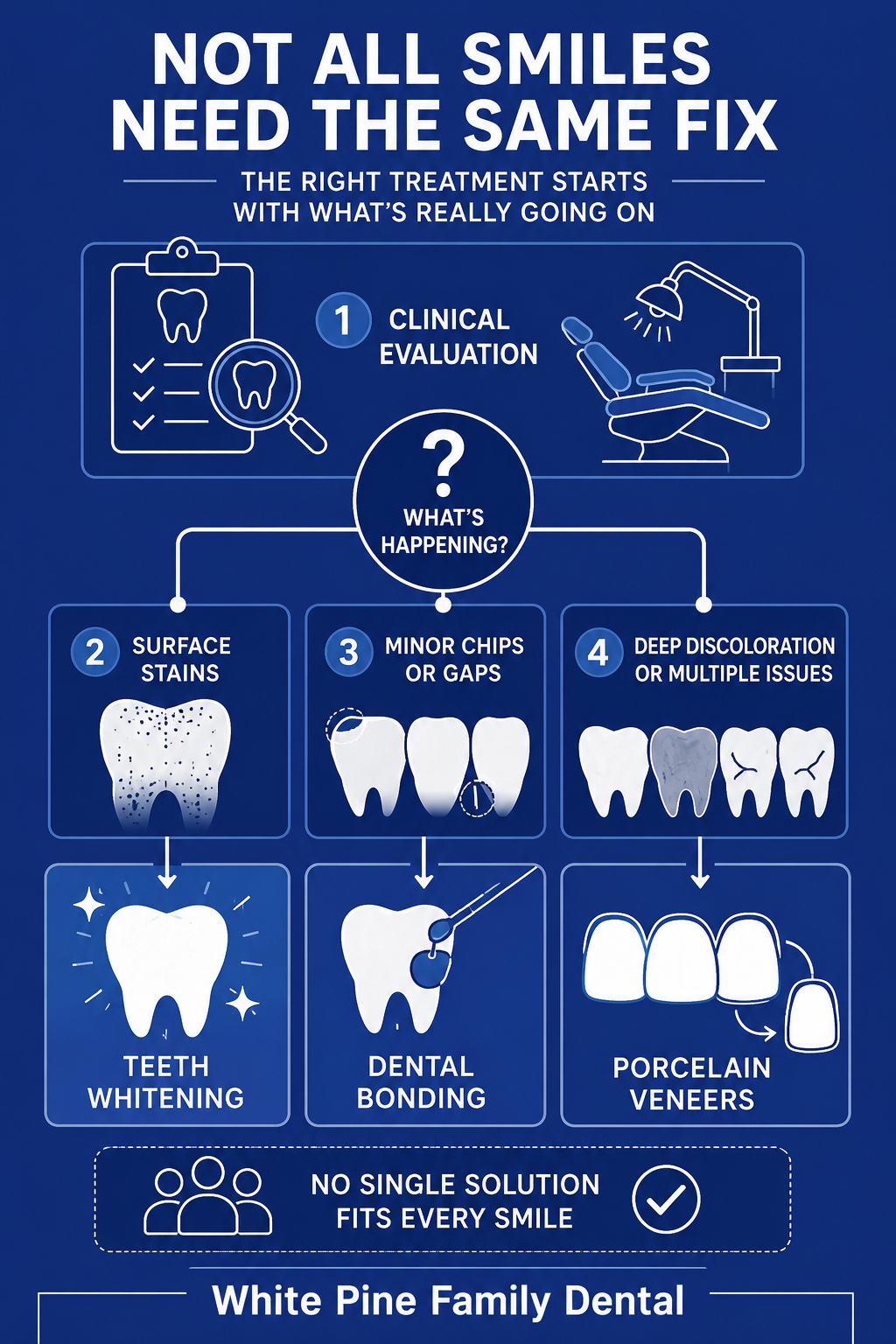
Which Option Is Actually Right for You
There is no universal answer, and any recommendation made before someone has looked at your teeth is a guess. A patient with surface staining and structurally sound enamel is a different case entirely from someone with gray teeth from tetracycline exposure during childhood. Same goal, completely different path. The only reliable way to know which direction makes sense is a clinical evaluation.
Schedule a Cosmetic Consultation at White Pine Family Dental
Our team has been caring for Reno patients for over 30 years, and our approach to cosmetic care reflects that. Drs. Prince, Papez-Berg, and Nguyen bring real depth to every cosmetic conversation, and our practice is committed to making sure patients leave with a clear picture of their options, not just a treatment plan pushed in front of them.
Whether you are weighing teeth whitening or trying to decide if veneers make sense for your smile goals, we will give you a straight answer based on what we actually see. When you are ready, reach out through our contact form to schedule a consultation with our team.