

You catch your reflection in a store window and notice it again, the way your bite never quite lines up the way it should. Maybe it is a jaw that clicks when you chew, teeth that meet at an odd angle, or a smile you instinctively hide in photos.
At White Pine Family Dental, we hear this question often, and the answer is usually more encouraging than people expect. Invisalign can correct many bite issues, including overbites, underbites, and crossbites, without the metal brackets and wires of traditional braces. Many patients are surprised to learn their bite can often be improved with clear aligners, even if they assumed braces were their only option.
Understanding Overbites, Underbites, and Crossbites
A bite misalignment, known clinically as a malocclusion, happens when the upper and lower teeth do not fit together properly. An overbite occurs when the upper teeth extend too far over the lower teeth, sometimes making the chin appear smaller than it actually is. An underbite is the reverse, with the lower jaw and teeth positioned in front of the upper ones, which can affect both appearance and everyday function. A crossbite happens when some upper teeth sit inside the lower teeth rather than outside, and it can affect the front teeth, the back teeth, or both.
These bite issues are far more common than most people realize. A peer-reviewed scoping review published through the National Institutes of Health found that crossbite prevalence alone ranges from under 7% to nearly 40% depending on the population studied, with overbite affecting an even wider range of children and adolescents worldwide. Left unaddressed, these misalignments can contribute to uneven tooth wear, jaw discomfort, and difficulty with everyday functions like chewing and speaking clearly. Many people live with a mild bite issue for years without realizing it can be corrected.
How Invisalign Corrects These Bite Issues
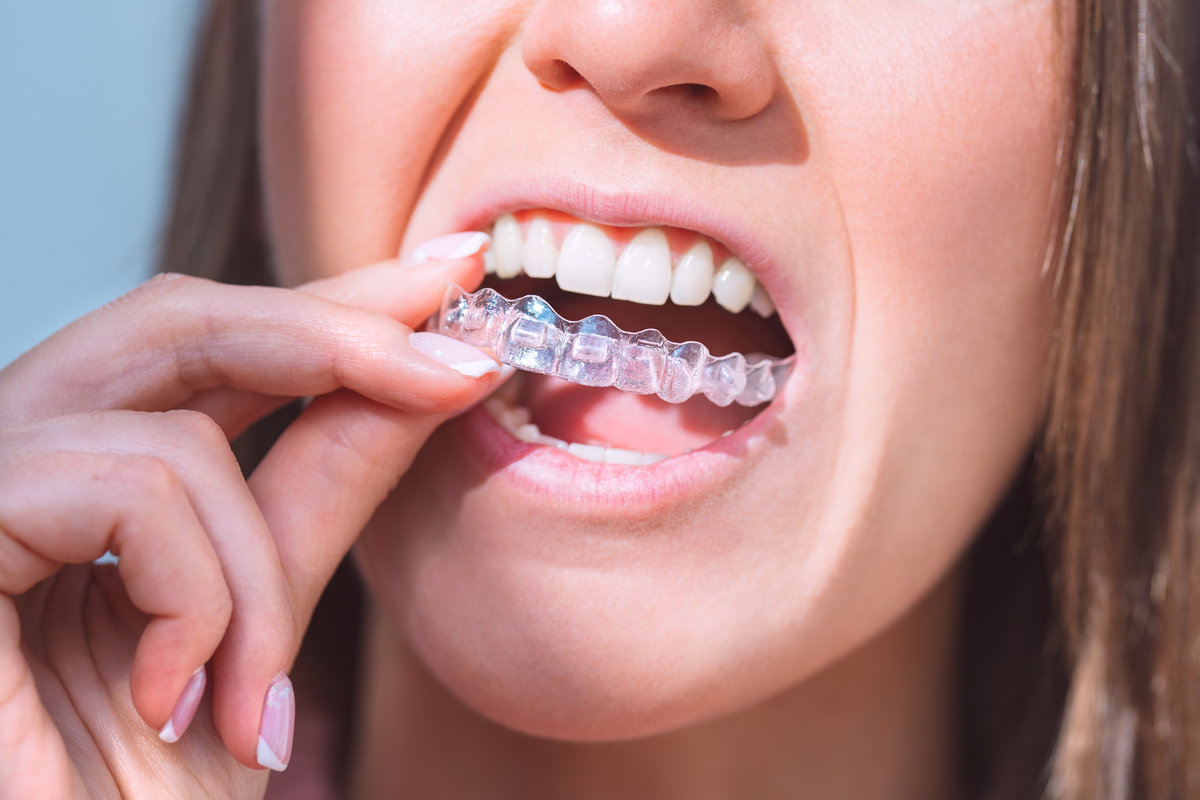
Invisalign uses a series of custom, clear aligners to gradually shift teeth into their ideal position. For an overbite, the aligners move the lower teeth forward or the upper teeth back to bring the bite into better alignment. For an underbite, treatment repositions the lower teeth so they no longer sit ahead of the upper arch. Crossbite correction often involves widening or adjusting specific teeth so the upper and lower arches meet correctly, which can also help prevent uneven jaw growth over time.
Every Invisalign consultation starts with a digital scan and a detailed look at how your bite currently functions, allowing our team to map out exactly how your teeth need to move, session by session, before a single aligner is made. This planning stage matters just as much as the aligners themselves, because a treatment plan built around your specific bite produces far better results than a generic approach. We are able to fix a bad bite in exactly this way, using a fully personalized progression rather than a one-size-fits-all approach.
Why the Type and Severity of Your Bite Matters
Not every bite issue responds to Invisalign in the same way. Mild to moderate overbites, underbites, and crossbites are often excellent candidates for clear aligner therapy, and understanding the full range of Invisalign benefits helps set realistic expectations. More severe skeletal misalignments, where the jawbone itself is significantly out of position, may require a combination of approaches or a referral for additional evaluation. Age can also play a role, as some bite issues respond differently in growing jaws compared to fully developed ones.
During a consultation, we look at more than just the teeth you can see. We consider jaw position, bite function, and the underlying structure that determines how your teeth meet when you close your mouth. A few points come up often during these evaluations:
- Bite depth: How much the upper and lower teeth overlap vertically.
- Jaw alignment: Whether the upper and lower jaws meet where they should.
- Tooth movement needed: How far individual teeth must shift to correct the bite.
Once we understand these factors, we can tell you honestly whether Invisalign is right for you or whether another approach makes more sense for your goals.
What Sets Treatment at White Pine Family Dental Apart
Dr. Kenneth B. Prince began providing Invisalign in 2004, just five years after the treatment became available to the public, and continues to pursue advanced training from leading Invisalign providers around the world. We take the time to evaluate how your teeth, bite, and smile work together so your treatment plan is designed around both function and appearance, not just one or the other. If additional cosmetic treatment would help you reach your goals, we can discuss those options as part of the same overall plan, so you are never left coordinating care between multiple offices.
If your bite has never felt quite right or you’ve been thinking about straightening your teeth, we’re here to help you understand your options without pressure. Contact White Pine Family Dental to schedule a consultation and learn what Invisalign could do for your comfort, confidence, and long-term oral health.